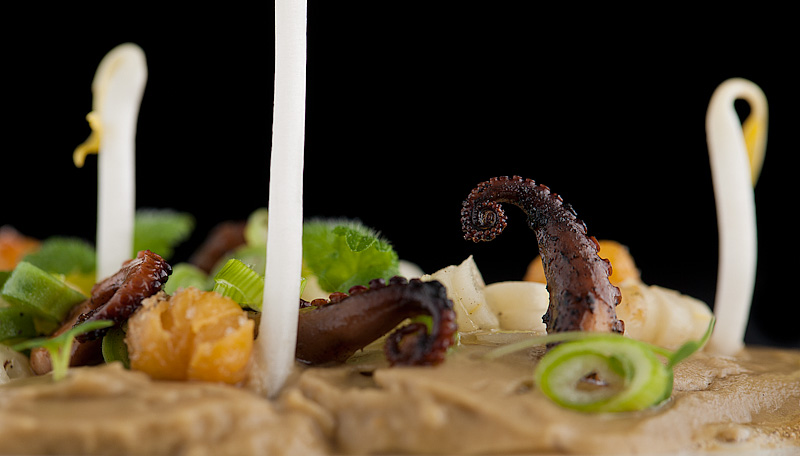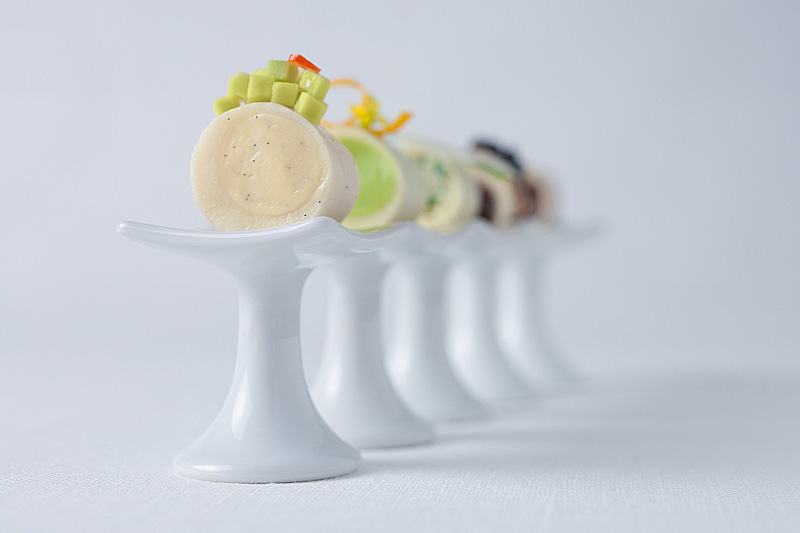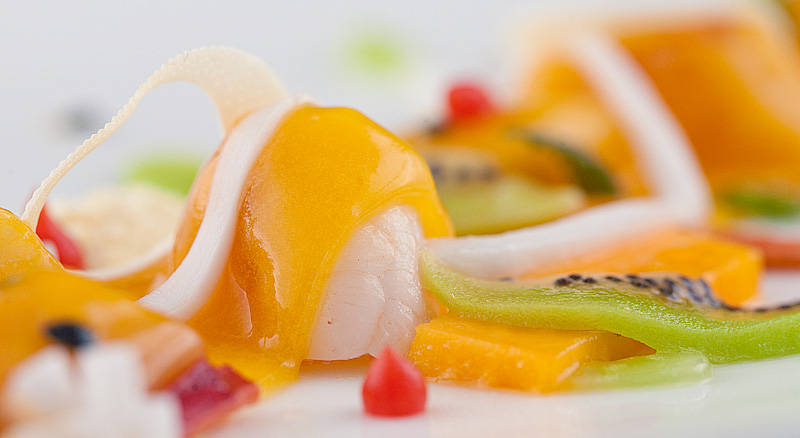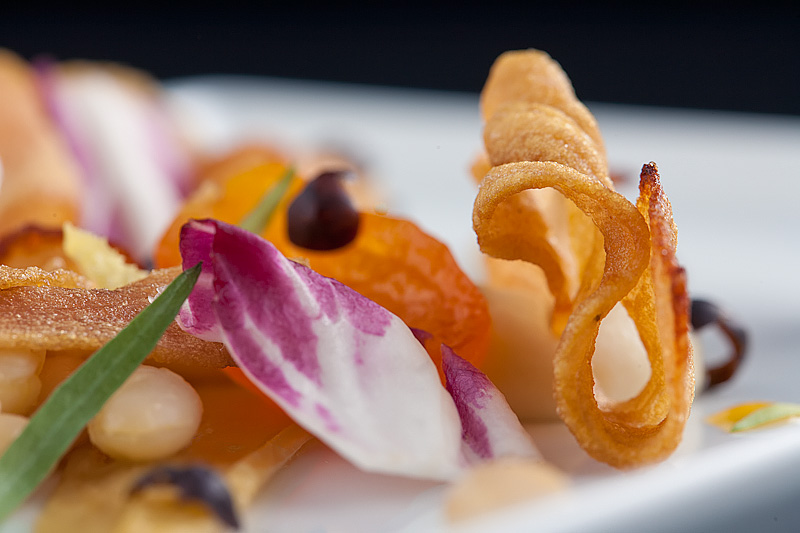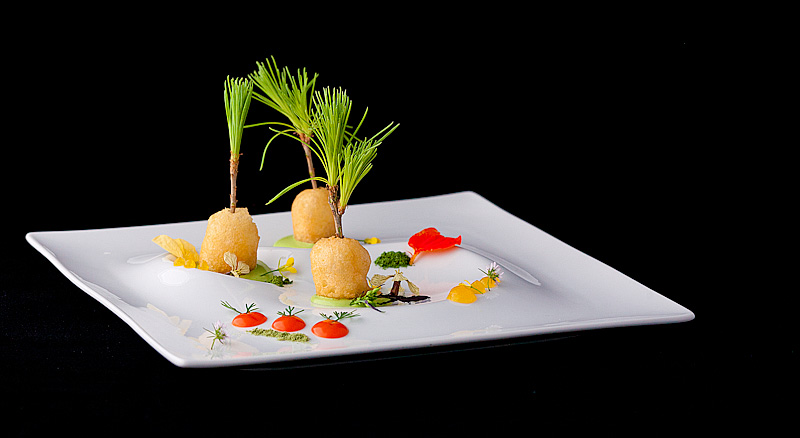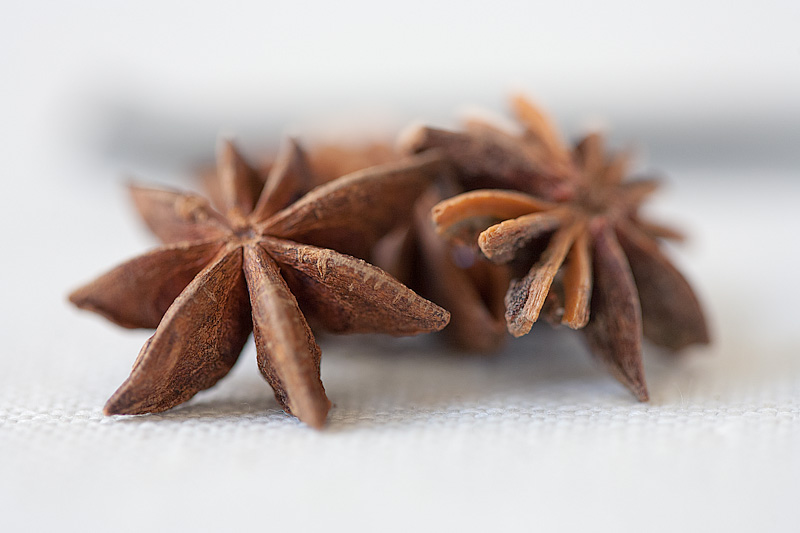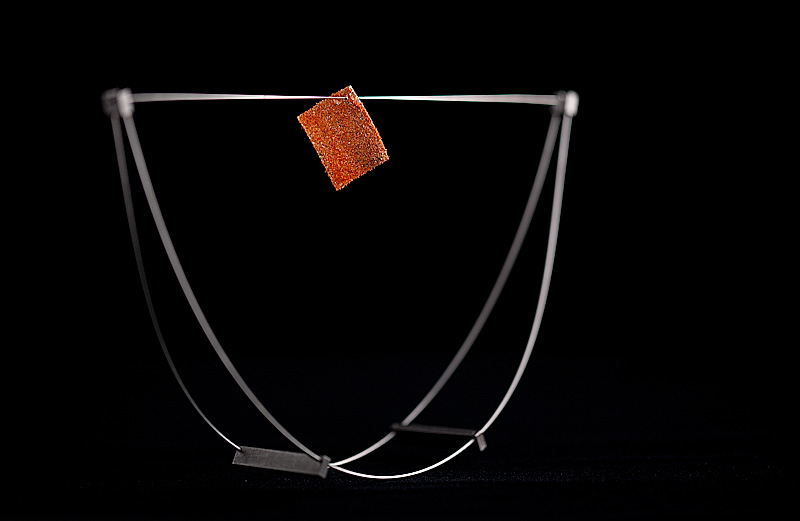
Persimmon, Aroma Strip, Carrot, Red Curry

2013, here we go.

Technically this dish falls in the Autumn menu for Alinea, but last year I didn’t get to make it through as many fall dishes as I’d have liked, so I’m hoping to cherry-pick a few of them throughout the Winter season to try to catch up a bit. The one super-seasonal ingredient here is Persimmon, which is still around in markets in the Bay Area but won’t be for long. Thankfully, Hachiya persimmons are right at their peak of ripe deliciousness; soft enough to feel like an overripe avocado, you can cut these things open and scoop them out with a spoon. They taste like sugary pumpkin, sort of spicy and sweet and very luscious.

What I did with the persimmons was new and peculiar to me; the pulp was pureed and mixed with egg white, all-purpose and pistachio flours, sugar, butter, and nutmeg to yield a mixture sort of the consistency of pancake batter. This mixture was sealed in a vacuum bag and cooked sous vide for 3 hours. There’s no leavening in the mixture at all. What I ended up with was a very dense, moist cake sort of like what you see in a bread pudding.  It had an almost-gooey quality, and tasted warm and spicy.

As a side note, I found pistachio flour a little tricky to come by — it’s not sold frequently in markets and is a little expensive. Since I was buying a lot of whole pistachios for the rest of this recipe, I wondered about trying to make my own. My Blendtec blender claims ability to make flours, but I didn’t need a ton of it, so I turned to another gadget that I’ve found surprisingly-frequent use for in the kitchen: the Magic Bullet. The small container (meant for individual-size smoothies) is perfect for making, say, a half-cup of nut flour (among lots of other uses friendly for home-scale production).

The cake is accompanied by a small scoop of “caramelized milk ice cream”. The base of this is made by combining some whole milk, half and half, and a small spoonful of honey in another vacuum bag and cooking at for 12 hours at 79C. This again was something really new to me; apparently the long cooking time causes the lactose (sugar) in the milk to caramelize slowly. I did a bit of googling about this; there are several sites that mention using this method to make Dulce de Leche (which is superior because you avoid the risk of scorching the milk), though the base almost always starts with sweetened condensed milk.

The book indicated that the milk should turn a tan color once the process was complete; mine was barely, barely tan and definitely had a different taste from uncooked milk, but the flavor was still quite mild. I’m not sure if this was ‘correct’ (compared to condensed milk, I think I had less sugar in my mixture), or if I could have eeked the temperature up by a few more degrees to get better caramelization. Still, pretty neat trick.

One of the coolest components to me were the Red Curry Raisins. I started with a mixture of carrot juice, red curry paste, xanthan gum and calcium lactate. I filled some spherical molds with this mixture and froze it overnight.

The next day, I transferred the frozen spheres to a warm bath of sodium alginate and sugar. The warm water causes the spheres to melt, and the alginate bonds with the calcium lactate to form a thin membrane around the contents of the sphere. The process of spherification isn’t one that’s terribly new to me on this project, but the next steps definitely were: after having some egg-yolk-like red curry spheres, I cured the spheres in a bowl of sugar for an hour; the hygroscopic sugar draws some water out from the spheres, thickening their texture a bit. This hygroscopy is balanced by the xanthan inside the sphere; the interior contents thickened to the consistency of honey.

After the curing process, the spheres were dehydrated for about 6 hours or so. During this time, they withered and crumpled to resemble red raisins. Again because of the xanthan they never fully dried out to the point of getting crisp; rather they more or less took on the texture of a real raisin. I think this is just so damn cool and inspirational — it’s easy to think that spherifying something is an end in and of itself, but carrying it past that point to hand-make flavored ‘raisins’ just reinforces to me how important it is to never stop being curious.

At the same time I was working through the curry raisins, I also worked on making ‘normal’ spheres from an infusion of ginger. I again froze spheres of ginger liquid and calcium lactate, and used the same alginate bath to spherify them. You can see how, around jagged areas of the frozen spheres, I get small imperfections on the surface of the final sphere…to get around this I flip the spheres over when plating them so we just see a perfectly smooth surface.

Garnishing the dish are shards of Hyssop Glass and a small Spice Aroma Strip. The former is meant to be made by pureeing fresh Hyssop leaves (which have sort of a savory mint-like taste) to yield a bright green shard of glass. I had trouble tracking down a fresh hyssop plant big enough to support how many leaves I needed for this, so I defaulted back to using dried hyssop and making a tea from the leaves. This tastes recognizably different (dried herbs have a definite cooked/dried taste compared to fresh ones, and I knew I was sacrificing flavor here). The hyssop infusing is mixed with Pure-Cote and left to dry on a sheet of acetate overnight to yield a thin ‘skin’-like sheet that I ripped up and dehydrated until it was crispy.  I last did this years ago, and learned the hard way how to optimize this process.

The texture ended up decidedly glasslike, but the final flavor wasn’t great. This was definitely due to using dried hyssop. The upside was that it was so mild that it really only offered a crispy textural component to the dish, which was still nice. I also forgot to flash the hyssop before letting it dry to get rid of errant bubbles, so it could have looked a bit prettier.

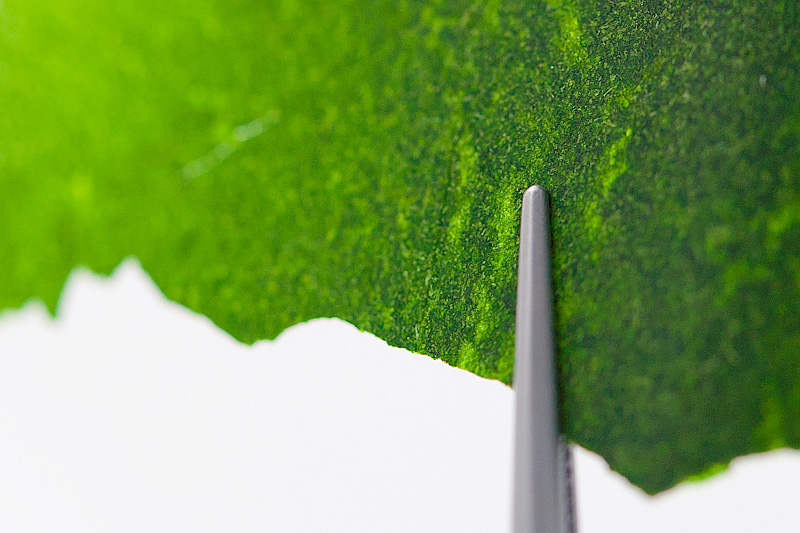
For the lackluster-ness of the hyssop glass though, my Aroma strips turned out quite nice. I toasted several fistfuls of clove, nutmeg, mace, and allspice, infused some sugar and water with the spices, then mixed the infusing with more Pure-Cote and poured this onto a second sheet of acetate. This mixture isn’t dehydrated, which leaves it floppy and similar in texture to a Listerine Breath Strip. The idea is that you’d eat this at the beginning of the dish, and (like a Breath Strip) it would stick to the roof of your mouth and dissolve slowly, contributing spicy aroma to every subsequent bite of the dish.

Because of surface tension, the Pure-Cote mixture does an interesting thing when poured onto acetate; it draws back up on itself a little, leaving these interesting, raggedy edges that I think are quire pretty. Alinea trims these away and presents the strips in small squares, but I kinda liked how the ragged edges looked.

The Grinch-Finger-looking thing is a glazed carrot; I chose a couple bunches of small baby carrots with intact roots at Berkeley Bowl, then cooked them en sous vide with honey until they were sweet and tender.

Standing apart from the main assembly of components is a small island of braised pistachios on a pool of puree made from dates and port. The pistachios are braised in a mixture of honey, water, and pistachio oil until they’re very tender. The cookbook specifies use of Iranian Pistachios for this component. On researching what sets Iranian Pistachios apart from Californian ones (answer: it’s not obvious that anything does), I found out that it’s actually illegal to buy Iranian Pistachios are the moment because the US has trade sanctions put into place by President Obama a few years ago because of Iran’s nuclear defense policies.

Finally, the bulk of the dish is covered (to the point of near-obscurity) by an amazing mix of ‘crumbs’. This crumb mixture contains pistachio brittle, pistachio shortbread, pistachio powder, honey crystals, and crispy carrot foam shards. The pistachio brittle is made by toasting some pistachios, then mixing them with sugar cooked to 342F (medium caramel stage) and baking powder. The baking powder causes quick leavening of the sugar, making it froth and lending the final crumbly texture to the brittle.

The pistachio shortbread was a bit different from other shortbreads I’ve made in that it uses “pastry flour”, which I learned is a low-protein whole-grain flour that’s useful because it can produce limited gluten bonds in doughs. This leads to very crumbly pastry, which is perfect for this dish because I ultimately needed to process the shortbread into a bread crumb-like texture.

Pistachio Powder is made with confectioner’s sugar, tapioca maltodextrin, and several cupfuls of pistachio oil. The sugar makes this stuff deliciously sweet, and the powder collapses instantly on the tongue, bathing it in rich pistachio flavor.

To make Crispy Carrot foam, I mixed carrot juice with a bit of water and sugar, then chilled the mixture overnight. The next day I mixed in some Methocel F-50 (I needed the mixture to be chilled to evenly-disperse the methocel), then whipped the mixture at high speed for 10 minutes until it took on a meringue-like consistency…very light and fluffy and airy. I smoothed this mixture onto a few dehydrator trays and dehydrated for several hours to yield some impossibly-light and crispy carrot shards, which I broke up and crumbled into the rest of this crumb mixture.


Finally I mixed in some “honey granules” (this is specifically what the book calls for). Honey Granules can be found at places like Whole Foods, but I find the term misleading; the product marketed in this way is usually small granules of Sucanat (crystals of unrefined cane juice) with a bit of honey added to lighten the color. The product has a molasses-y taste sort of like mild brown sugar, but isn’t much like honey at all. It’s entirely possibly Alinea uses this exact product as a textural thing in addition to adding some sweetness (the granules are a bit crunchy).

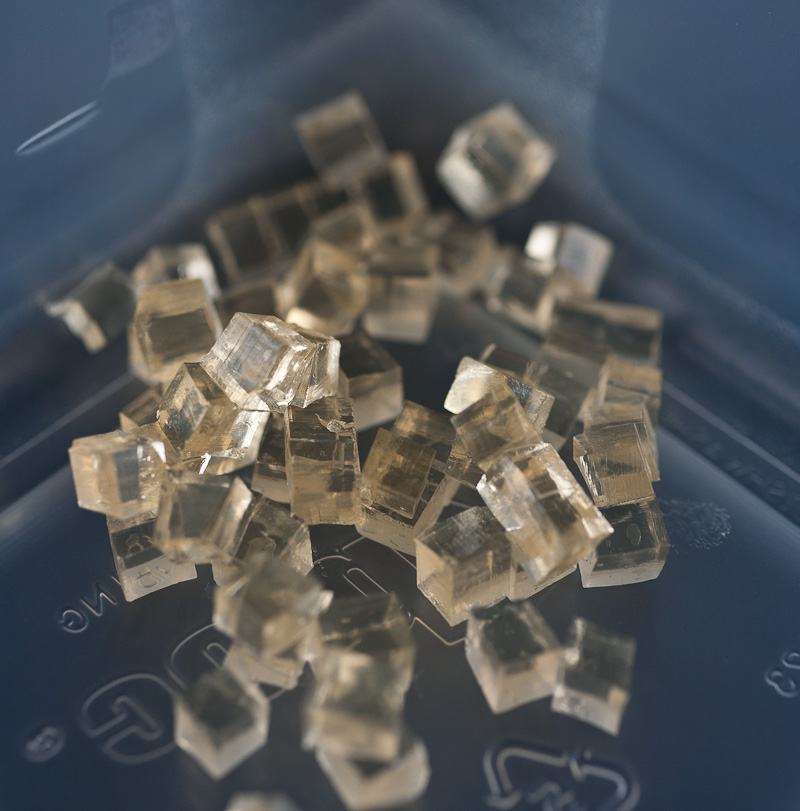
But, in placing a large order with The Spice House a few weeks ago to prepare for a few upcoming dishes, I came across a curious product on their site called “Crumiel”.  Some research taught me that it’s part of El Bulli’s “Texturas” line of products, and is crystallized honey. I hadn’t played with it before, so I snagged a small container. The crystals are small (like salt flakes, but not powder) and crispy, and taste much more richly of honey than Honey Granules, so I opted to use them instead.


The final Crumb mixture is very light and fluffy (thanks to the help of the pistachio powder), and looks like “autumn dirt”…the browns and oranges and greens are very fall-like. The taste of this stuff is just beautiful; it’s sweet and warming and spicy, and the carrot notes give it an interesting dimension.

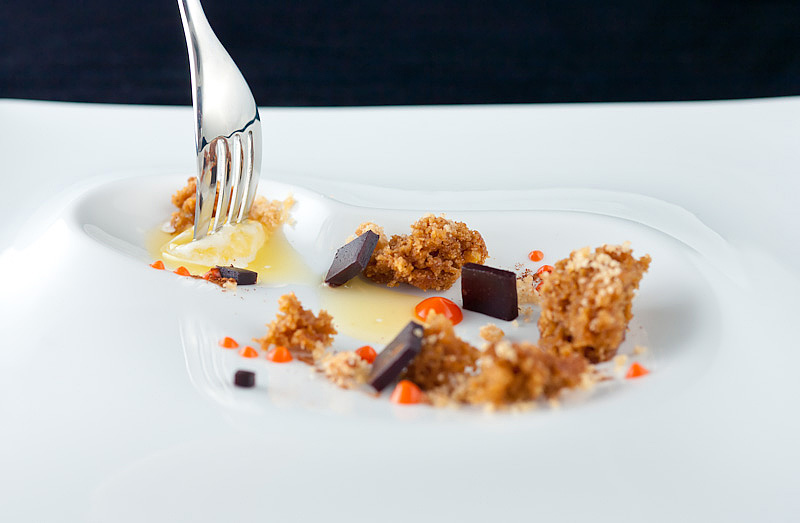
The final assembly of the dish is surprising for Alinea; they usually are pretty specific about separating flavors and ingredients into disparate zones on a plate, but this is just a ‘pile of stuff’: the persimmon cake and caramelized ice cream are plated in a well on top of some verjus sauce (made with golden raisins and verjus), then topped with a big pile of the crumbs and garnished with a carrot, a ginger sphere, a red curry raisin, and some small dice of pear. It’s hard not to just scoop up a big bite of everything, and difficult also to pick apart the flavors…but that’s ok because it’s so delicious. There’s a nice contrast of temperatures (ice cream and cold ginger spheres, warm persimmon cake and carrot), and the flavors are just beautiful. There’s a lot of nice textural contrast going on here too. I love the Aroma Strip; it tastes nearly like chai tea and lingers on the palate throughout the time eating the dish. And though the flavors are clearly and obviously autumnal, I’m not going to complain about eating it in the dead of winter.

Bitters, En Sous Vide

20121211_parkAveProvisions_0020

In continuing with my little sidecar Bitters adventure I’ve been on: I recently participated with some friends in a craft fair; these friends and I have each been experimenting with making Bitters this year, so we thought it might be fun to collaborate on a “cocktail kit”. One of the friends is a fairly accomplished (and incredibly knowledgeable) bartender, so her idea was to come up with several interesting Bitters flavors, accompany them with some equally-interesting flavored syrups, and then develop some cocktail recipes that made use of everything.

Because we had a deadline to have everything ready, in the interest of buying myself more iteration time I pressed forward with my experiments to shorten the process of making bitters. I was recently at dinner at Haven in downtown Oakland and was chatting with the bartender about his house-made bitters and liqueurs; I asked him how he made his liqueurs, and he mentioned leveraging the kitchen’s sous vide setup to rapid-infuse spirits with fruits. When I got home I immediately started searching the intertubez for more information about this, curious if anyone had tried this technique for making bitters (or, at least, if they had written about it). I couldn’t find much; there was one article wherein the author describes using sous vide with gin and juniper to heighten the juniper flavor (assisted by the inimitable David Barzelay, I was excited to find), which was all I needed to confirm that this was probably Science Worth Doing.

I came up with three flavor profiles I wanted to play with:

  • “Napa” bitters, made with rosemary, fennel, fig, and black pepper, aged in a port wine barrel that a friend loaned me
  • “Bay” bitters, made with bay leaf, apple, date, and juniper berries
  • “Granny” bitters, made with rose, pistachio, vanilla, and walnut

My friends came up with a few others:

  • “Manhattan” bitters, containing traditional flavors of clove, vanilla, cardamom, orange
  • “Barbados” bitters, made from rum, lime, and various Tiki-style flavors
  • “Temple” bitters, stemming from the idea of making bitters from Grenadine

20121211_parkAveProvisions_0002


I’d never made any of these before, and all my recipes for bitters are measured to account for a slow, 4-week-long infusion process. I wanted to try sous-vide, but wasn’t sure what temperature to aim for, how long it should take, or how much product I needed for the infusion. I started with the same amounts called for in the slow-infusion recipes, and arbitrarily chose 135F and 2 hours as starting points for my experiments.

These values turned out to be not-too-far off the mark. The most obvious thing I noticed from this approach is that some ingredients infused extremely well (vanilla, juniper berries, the fruits), while others came out tasting ‘cooked’ (the bay and rosemary especially). Their contribution was clear and present but some of the more-delicate notes you get from super-fresh herbs was lost. The ingredient that suffered the most was the rose petals; their delicate scent was crushed under the weight of the nuts and vanilla.

The cool thing was that I didn’t have to start over; I just built on top of the foundation the sous vide offered. I added more rose petals, rosemary, bay, and other ingredients that I felt didn’t stand up to the heat, and let this mix infuse at room temperature for a few days. The good thing is that herbs infuse much more quickly than ‘hard’ spices or woods, so I could divide the process into two fast steps: sous vide infusion of hearty flavors, then cold infusion of delicate stuff. Plus, because I was building on a layer of cooked herbs, there was quite a bit of depth and complexity to their notes. In the end I was pretty happy with each of the flavors, and we came up with some nice cocktails to build off them. The Napa one I felt was the most interesting and well-balanced, while the Rose one (while I personally really loved it) was more of a challenge (Rose is a really polarizing flavor, and it’s tough to wrangle it with other ingredients).

We paired our bitters flavors with 4 flavored syrups to use in place of traditional simple syrup. Some of the cocktails flavor pairings we came up with were:

  • Brandy, Gin, Lemon, Napa Bitters, Late Harvest Cordial (a syrup made from reduced Zinfandel wine from a local vineyard)
  • Mezcal, Lime, Cinnamon-Vanilla Syrup, Granny Bitters
  • Bourbon, Demerara Syrup, Bay Bitters

20121211_parkAveProvisions_0010

Sarah helped brand everything for us, and we chose the name “Park Avenue Provisions” to sell under (the craft fair was on Park Avenue in Emeryville). It ended up going pretty well and we sold out of most of what we’d made, which was pretty surprising/cool to me! Maybe I’ll try this again next year…


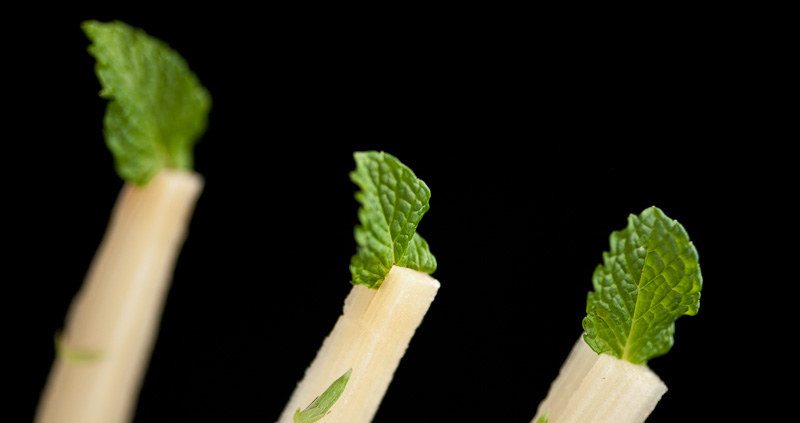
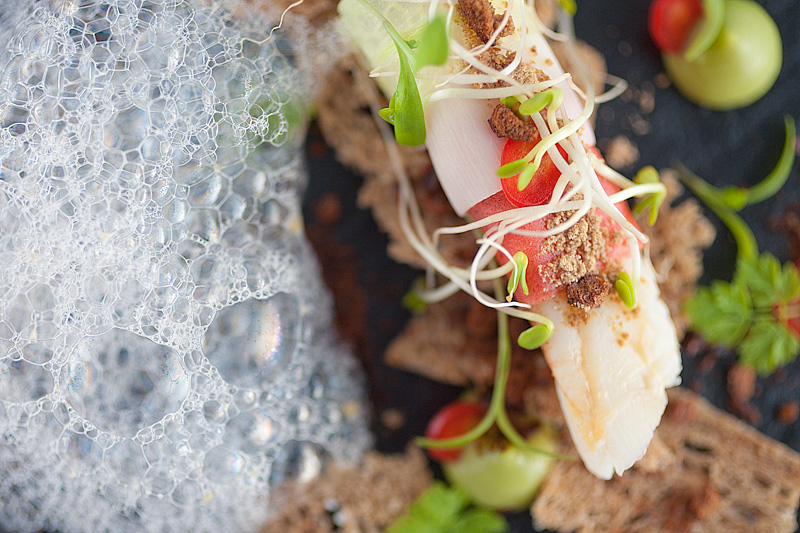
Salsify, Smoked Salmon, Dill, Caper

Smoked salmon mousse, lemon-saffron pudding, herb powder, flakes of smoked salmon filet, garlic chips, logs of salsify rolled in olive oil mayonnaise and a powder of smoked salmon, caper, red pepper, ginger, and lemon peel, toasted bread crumbs with olives and olive oil powder, dill sauce.

This is Bagels and Lox, Alinea-style.

This dish calls for several lbs. worth of smoked salmon. Rather than buying shrink-wrapped smoked salmon chunks in the refrigerated meats section of a supermarket, I’ve been extremely excited for an opportunity to make it myself. Back down at Weta, there’s a guy named Steve who works in our finance/payroll department. Steve keeps a reasonably-close eye on the price of salmon in Wellington, and when it drops below a certain threshold, he buys a whole side and smokes it, then brings it into work early one (usually-unannounced) morning and makes homemade bagels in one of the kitchens. These mornings are one of my favorite little quirks about Weta; it’s so awesome to groggily come in to work to be greeted by the smell of warm bagels and fresh-smoked salmon made just for the hell of it by a cool coworker.

Sarah and I stayed in New Zealand one year for Christmas, and a traditional thing to do on the summery, warm Christmas Day down there is smoke a salmon or have a BBQ.  I asked Steve if he could teach me how he made his salmon. Because it’s so awesome, I’m sharing his technique here.

  • Find a delicious fresh side of salmon. Buy the whole thing.
  • Mix up a large brine of cold water and salt. It should, as Steve instructed, taste like the ocean. You can do this in a big stock pot or a casserole dish, just whatever the salmon will fit into easily and be covered by the water. Leave this to brine in the fridge for 2-3 days. This process is vital for two reasons: 1 it seasons the fish to heighten its flavor, and 2) it gently cures the fish. This last bit is important because salmon are part-freshwater creatures, and as such can contain parasites which are cleansed by the brine.
  • Remove the fish from the brine and transfer it to a sheet tray. In New Zealand, it’s commonplace for the oven in one’s kitchen to have a circulating fan. If yours does, place the fish in the oven with ONLY the fan on, and leave it to dry overnight. We want to gently dehydrate it. I once, in the absence of a fan in my oven, left the fish in it with it set to its lowest temperature and the door cracked. This sorta worked but also partially-cooked the fish, which we’d like to avoid. A more-ideal solution if your oven doesn’t go down to around 130F is to leave the salmon uncovered in the fridge. The cold circulating air will gently dry it just the same.
  • The next day, smoke your fish. In New Zealand you can get small box smokers for pretty cheap at the Warehouse; you fill them with a layer of soaked wood chips and place a pretty-scary little tin of methylated spirits under the box to heat the chips and trigger the smoke. These super-handy things are very difficult to find in the US; I have a kettle grill here, so the way I do it is: I stoke some coals on one side of the grill, and toss soaked wood chips on them, and place a big bowl of ice on the other side of the grill. The salmon goes onto the grill grate above the ice. The ice helps keep the temperature down and add moisture to the chamber.
Ideally what we’d like to do here is smoke the salmon at as low a temperature as possible. “Cold-smoking” as a process usually involves lower temperatures (68 to 86 °F) and at the end of the process the food isn’t actually cooked (if you’re going to eat it after cold-smoking, it needs to have been cured first). To cold-smoke something you obviously need to get the heat away from the item being smoked, and ideally be able to control the temperatures of both the smoke-generator and the smoke-receiving area. Hot-smoking involves higher-temperatures (126 to 176 °F) wherein the food ends up cooked at the end. With hot-smoking, the closer you keep the temperature to the final desired temperature of the food (as in sous vide cooking), the more moist and tender your product will be. With my Weber it’s a little tricky to get the food far enough away from the coals to keep the temperature around the 135F I’d like to keep it, hence the ice cubes. I also cut back on coal to reduce the amount of fuel that can be burning at once. NZ’s methylated spirits box, ghetto though it looks, works just beautifully at performing this task.

I’d like to think Steve would be proud at the lovely side of smoked salmon I ended up with; every time I make this I kick myself for not making it more often. It’s so flavorful and sweet and delicious I could eat it all day long. BUT NO! This time around, this filet would be separated and processed three ways. First, I froze a chunk of it and shaved it with a microplane into a fine ‘smoked salmon snow’, which was then dehydrated into a crispy powder. At the same time, I also dehydrated some slices of candied ginger, candied lemon zest, red bell pepper, and capers. These were all crushed together in a mortar and pestle to yield “Smoked salmon vegetable powder”.

While these were dehydrating, I also made a mayonnaise from egg yolk, lemon juice, some salt, and some fresh olive oil. I wrote a bit in my last post about tasting different olive oils; a few days after that experiment I was talking about this with Erik, who recently read the book on olive oil I keep mentioning (I swear I’m not shilling). He remembered that the book mentions an olive oil market in Berkeley that’s noted as a great resource for those wanting to learn more about this. So he and Vanessa and I went up to Amphora Nueva for a few hours of olive oil scrutiny. Amphora has dozens of fresh olive oils (one section featured olive oils pressed less than a week ago), and each stainless steel dispenser features extensive tasting notes. For as subtle as the differences in the Lorenzo oils were, the oils at Amphora were recognizably unique and vibrant. “The freshest ones will be more pepper-forward,” advised one of the ladies attending the shop, “while the ones that are a few months old will have mellowed, and will have more subtle, delicate notes you can get at.” There’s a section of Australian oils that are crisp and clean, there are robust Californian oils with grassy green apple and pepper notes, and a collection of Chilean oils that have vibrant tropical notes of banana and papaya. The oils are seasonal, rotate frequently, and you can buy empty bottles there and fill them yourself (the smallest size is $7, the largest is $12). I chose a bottle of the Chilean oil for the mayo I made here.

The olive oil mayo and vegetable/salmon powder are mixed to coat some salsify root. Salsify, exotic though it sounds, seems to be reasonably-consistent to find at Berkeley Bowl. For this recipe I peeled the salsify and packed them in butter and thyme, then cooked them en sous vide until they were nice and tender. Just before plating, the salsifies were warmed, rolled in the mayo, then dredged in the vegetable powder to yield a warm, buttery, yummy bite.

A second chunk of the smoked salmon was pureed with some water and olive oil, then mixed with whipped creme fraiche to yield light and fluffy Smoked Salmon Mousse. This is garnished with chips made from pureed garlic, chive tips, dill fronds, and Toasted Bread Crumb powder. The latter there involved baking some bread drizzled with olive oil, salt, and pepper at a very low temperature for about an hour until it was very dry and crouton-like, then crushing it with some dehydrated olives, parsley dust, and a powder made from olive oil and tapioca maltodextrin. A bite of the mousse and crumbs is straight-up bagels and lox, albeit impossibly refined and delicious. As I worked through the rest of the recipe, I kept stealing spoonful bites of the bread crumbs and the mousse, it was just so damn tasty.

The third bit of salmon was cooked in olive oil until it was tender enough to flake apart easily. While this was cooking, I worked on making a Lemon Pudding from water, sugar, lemon zest and juice, agar agar, and some saffron for both color and flavor. Were it not for the saffron, the pudding turns our relatively colorless, but Alinea isn’t content to use only enough saffron for color. The recipe calls for a couple grams, which is enough to give the pudding considerable delicious saffron flavor. Saffron usually is packaged in 0.5g silly little boxes or tubes in most grocery stores I’ve found, but someone turned me onto this site that sells it in bulk for WAY cheaper. A 5g tin of it is pretty reasonably-priced and yields me enough to not be too bashful about using it liberally, which is awesome because the flavor of saffron is beautiful.

The final component here is a dill sauce, made using surprisingly-traditional methods. A roux is made from flour and butter; into this is mixed some cream and shallot and cooked until it thickens into a lovely sauce which is then transferred to a blender with a couple bunches’ worth of dill fronds and pureed into a beautiful deep green sauce. This is plated warm with some tiny radish dice.


The flavors here are more or less unsurprising, but that’s exactly what makes this dish so comforting (and clearly everything is extremely refined and maximally-delicious). I think in the midst of a meal that involves no shortage of challenges, a respite of familiar, warm, comforting flavors is vital to re-center the palette. Sarah surprised me this weekend with a meal at Coi, which was beautiful but left me feeling a little off by the end (frustrating, given the exclusivity and cost) because the courses in their tasting menu seemed to get increasingly disorienting as the meal progressed, with fewer and fewer familiar or comforting flavors as we neared the end. It was the first time I’d felt so oddly exhausted at the end of what would have otherwise been a lovely menu, and in thinking about that I feel a part of it was due to this thing that Alinea understands…that sometimes it’s ok to pull things back to the realm of the comforting.


Crab Apple, White Cheddar, Eucalyptus, Onion

A couple weeks ago, Sarah and I did a bit of traveling overseas. The day before we left, Sarah called me to let me know she was standing in front of a big bin of crab apples at Berkeley Bowl. I missed crab apples by a few weeks last year, so — wary of the flightiness of bay area seasons — I asked her if she could buy me a few pounds of them.  I knew I couldn’t use them immediately, but for this recipe I would be cooking them en sous vide with some salt and sugar before making a puree of them, so I figured freezing them for a few weeks until I was ready to use them would be safe. The crab apple puree would eventually be frozen into a sorbet, then paired with onion jam, white cheddar sauce, olive oil jam, eucalyptus gel, and a black pepper tuile.

On getting back from our travels, I thawed the crab apples for a few days before cooking them in bags in a big stockpot of warm water until they were tender, then pushing them through a tamis to remove the skins and isolate the pulp (an incredibly tedious and hand-cramp-prone process). The mixture gets no more complex than that, though the book directs me to measure the sugar content of the puree with a refractometer before turning it into a sorbet with an ice cream maker. I didn’t previously own a refractometer (and had it in my head that this very exotic-sounding tool would be very expensive), but some searching led me to some pretty reasonably-priced options (they only start getting expensive when you go digital with them) so I snagged one to use here.

The refractometer I bought works by measuring the angle at which light refracts through a given solution that I’m measuring; there’s a small glass plate that I add a few drops of solution on, and a blue plate inside the refractometer that casts a shadow onto a gauge that I look at through a small eyepiece on the device. The line of the blue shadow moves depending on sugar content of the solution; using plain tap water, we can see the line falls at 0 Brix, indicating that the refractometer is calibrated properly (here I’m shooting through the eyepiece with the camera on my phone):

After smooshing my cooked crab apples (and the sweetened juices that resulted from their cooking), I put a few dabs of the puree on the refractometer’s glass and checked again:

The line is a little fuzzy here because the puree is thick and contains whole cells of the apple’s pulp, but it’s clear that I’m getting a reading above 20 Brix here. I don’t think there’s anything wrong with this (the book says “Add enough sugar so that the mixture reads 20 Brix), it just means my batch of crab apples was particularly sweet already.

My sorbet mixture was, however, a little odd to me; it was more the consistency of smooth applesauce than liquidy, and when I spun it in my ice cream maker it took on an odd, whipped, almost-aerated texture, and it felt grainy/mealy on the tongue when I ate it. It tasted lovely though: tart and sweet and autumnal. But my curiosity was in overdrive, and given the oddness I had with my frozen tamarillos a while back, I wondered if freezing fruits causes overt rupturing of cell walls (and therefore overt introduction of too much pectin into the equation) that was leading to this funky texture.

I went back to Berkeley Bowl and found they still had crab apples, so I bought another couple of pounds, came back home, and remade the sorbet from unfrozen apples. The cooked apples seemed to give off more juice and my resulting puree was notably more liquid, but there was still a bit of an aerated texture and a mealy mouthfeel to things, though again it tasted fine. It’s only occurring to me as I write this that the other common factor with the tamarillo incident is the use of the tamis, and I’m curious if that tool introduces microbubbles into things and/or the grid mesh is coarse enough to lead to a mealy texture. I think I might try thawing the sorbet, blending it at high speed to further break up any cells and liquify it more, and try refreezing it to see if I can get a smoother texture.

Berkeley Bowl’s olive oil aisle is a force to be reckoned with; there are hundreds of different brands and bottles neatly lining the shelves and it’s very easy to get lost. After reading an eye-opening book about olive oil last year, my curiosity is piqued to learn more about the nuances of flavor in them. I have a few brands I know I like, but since I was making an Olive Oil Jam for this dish and knew the delicate flavor of whatever oil I chose would be front-and-center, I took a fair bit of time roaming up and down the aisle trying to pick something nice. I eventually landed on these two, mostly because they seemed to allow for a tightly-contemporaneous tasting. They’re by the same olive oil maker, from the same farm, and were harvested and bottled the same dates.

The two oils are made from two different olive cultivars, and are expelled from pitted olives (a process which claims to remove ‘bitterness’ from the oil). I brought both home and did a side-by-side tasting of them. The first obvious thing I noticed was that they’re both delicious…easily among the better oils I’ve tasted, with a lovely creaminess and a nice bite of pepper at the end that the aforementioned book notes is the sign of a fresh/good oil. But I had to really, really hunt for further differences between the two…which turned out to be eye-opening and kind of fun. I asked for help from Supertaster Sarah, who can usually pick up on subtleties of things that I can’t, and even she had trouble with it. “Tastes like olive oil,” she commented.

There’s a huge part of me that feels that talking about this is incredibly douchey, beyond the pale of foodie masturbation, a real first world problem. But there’s another part of me that wants to think and talk about this meaningfully. So I kept at it, tasting small sips of one, then the other, straining to understand if there were differences and whether any of this mattered. Eventually I got to a point where I could ‘taste through’ the similarities, and could sense the subtle differences between the two. It took a while, and was a bit of a eureka moment for me. The No. 5 was softer, less assertive, less fruity. It was smoother and milder, whereas the No. 3 was a bit brighter, a bit higher in amplitude. But man, you really gotta want it to see that, and for my purposes either of these would work fine. I went with the No. 3, and my olive oil jam turned out very vibrant and delicious.

I went through this same rigamarole to make White Cheddar sauce, a simple sauce made from pouring hot milk over shredded cheese to melt it smoothly. I bought three sharp white cheddar cheeses, one from Black Diamond and two from Cabot, and brought them home to taste them. The differences where were appreciably un-subtle, and I chose the Black Diamond to work with. When I poured hot milk fresh off the boil over the cheese and whisked it to melt, I ended up with a grainy, sandy mixture that didn’t seem to want to smooth out regardless of how much I stirred it. Puzzled by this, I tried again with one of the Cabot cheeses, which yielded the same problem. To the intertubes!

After some searching, I found what I think was the problem; several sites mention grainy melted cheese as the result of too-high melting temperatures. For the third attempt, I let the boiled milk cool for a bit before pouring it over the cheese, then held the bowl over (not on) a burner while I whisked. This turned out much smoother. I can’t really find any technical information about why this happens…is it in Modernist Cuisine? Only time and several more set-aside chunks of my paycheck will tell.

Yet another challenge I ran into was making Eucalyptus Pudding. At first blush, this recipe seems pretty standard-fare for the cookbook: I’m meant to make a sweet gel from water, sugar, citric acid and agar. The sweetness and citric acid offer flavor to what would otherwise be a largely-aromatic thing. The recipe calls for 500g water, 125g sugar, some citric acid and 12g agar. Usually I’ve found agar will gel at a concentration of 0.5%, and most successful recipes in the book use between 0.5% and 1%…any more than this causes trouble. The 12g seemed enormous to me, so I cut it down and went about making everything else as usual. When I let the mixture cool to set, it just didn’t. Surprised, I figured maybe the citric acid had something to do with this. I remelted the mixture, added more agar, and let it set again…and again it failed. I started all over again, this time using even more agar.  All told I made this component 5 times, eeking up the agar each time until finally finding that an amazing 42g finally caused the gel to set, albeit in a very odd, pastelike way (rather than a gel, it looked like really thick glue).  This was totally fascinating to me; I knew acid had an effect on agar gels but hadn’t seen it in action so fiercly before. As it stood, 42g of agar is enough that you can clearly taste it…at that high of a concentration the gel was not only sweet and tangy but also oddly seaweedy from the agar. For shits I forged ahead with it, adding it the prescribed 10g of eucalyptus oil to flavor it and mixing until it was uniformly incorporated. 10g of eucalyptus oil is about 1/3 of a ‘regular-sized’ bottle of essential oil…in other words, a shit-ton. My kitchen smelled like the Cough Drop Fairy had spontaneously-combusted in it; Sarah, upstairs in our loft, called down, “Whatever you’re doing down there is clearing the hell out of my sinuses”.

Then I tasted it. The mixture was absolutely the most vile, inedible thing ever. The oil is incredibly bitter; this on top of the acidic tang and seaweed flavor made for something that looked like wallpaper glue and just tasted terrible.

Rather than retracing steps that I was pretty sure would lead to the same outcome, I took a step back and decided to go with what I knew. I got a few twigs of fresh eucalyptus, steeped the leaves in just-boiled water for about 20 minutes to make a strong but not bitter eucalyptus tea, then mixed this with sugar, much less citric acid, and a reasonable amount of agar. The omission of an overt amount of acid made the agar behave much better, and using eucalyptus leaves rather than oil got rid of the awful bitterness present in the previous batch. What I ended up with was a clear gel that tasted fresh and minty and sweet, with just the slightest bit of tang to add a little sumpin’ sumpin’ to it.

The other components were thankfully incident-free; I made Onion Jam by slow-cooking a Maui onion in a syrup of sugar and water. I’d read about Maui onions in a Nobu cookbook I have, which mentions their sweetness, and found them at Berkeley Bowl. Having never tried them, I was curious if they’d be recognizably-different from other sweet onions like Vidalias or Walla Walla onions; turns out, not much! But they still yielded a lovely sweet jam that tastes lightly of caramelized onion. And the black pepper tuile was made from a mixture of cooked fondant, isomalt, and glucose with flecks of crushed black pepper sprinkled throughout.

Overall the flavors of most everything were nice, and I found the combinations of the crab apple and onion and olive oil jam to be really delicious. The white cheddar, eucalyptus, and black pepper were a little disparate and odd to me…not un-delicious, but I just couldn’t quite make sense of them.


Black Sesame, Green Tea, Chocolate, Miso

Friday night I was flipping through a friend’s copy of Natura, a collection of desserts from El Bulli by Ferran Adria’s brother, Albert. I came across a section detailing some of the techniques they used for the desserts, and one in particular caught my eye. El Bulli refers in several dishes to “cake-m” or “sponge-m”, which I thought was a funky translation at first, but they go on to elaborate that oftentimes they stumble across a technique that has no precedent, so they make a name up for it. The “M” in this case stands for “microwave”; the technique basically involves creation of a sponge cake batter that’s squirted from a cream whipper into a plastic cup before being microwaved.

To explain why this is interesting: in baking, when one wishes to create a fluffy pastry with cakelike consistency, there’s one vital ingredient needed — air. Most cake batters include eggs and some sort of leavening agent, be it yeast, baking powder, or baking soda. The leavening agents react with the rest of the ingredients to form bubbles: yeast eat sugars and release carbon dioxide, baking soda (sodium bicarbonate) reacts with acids in the batter to generate bubbles of CO2, and baking powder self-reacts in the presence of moisture (baking powder is a mixture of baking soda and some acid — usually tartaric acid). When this aerated mixture is heated, steam collects in the bubbles and causes the mixture to expand (‘rise’). This goes on until the temperature of the mixture reaches a point that causes the eggs to set, which firms the structure and yields a fluffy cake.

Knowing this, we can shortcut things a little: El Bulli uses a cream whipper rather than any leavening agents. Filling a cream whipper with batter and charging it with a couple of NO2 cartridges causes the mixture to be instantly aerated as it leaves the whipper. This is the exact same technique used in canned pancake batter: the pancake mixture is sprayed onto a hot iron griddle, and the relative thinness of the batter and heat of the iron causes the batter to rise and set relatively quickly, before the NO2 bubbles have a chance to dissipate.

Recognizing that we need to heat things pretty quickly using this technique, El Bulli turned to another fast source of heat: the microwave. The microwave is interesting as a heating source because — unlike traditional heating methods like ovens or stovetops, which rely on convection for heat to travel through the medium (often resulting in a thermal differential that causes some parts of the medium to be cooked more than others) — the microwave heats uniformly using high-frequency electric fields to excite water molecules throughout the cooking medium. El Bulli fills a disposable cup with aerated sponge cake batter, then microwaves it for a minute or so…the fast, uniform heating causes the cake to rise and set firmly without a high thermal gradient involved. The result is a sponge cake that’s evenly-cooked throughout, and which is extremely moist and fluffy. Pretty damn awesome.

This process seemed so easy and neat that I had to try it. Natura provides a recipe for Black Sesame cake-m, which I recognized as something served at Next during their El Bulli menu, so I figured I’d start there. I made some sesame paste from black sesame seeds and sesame oil, then combined this with eggs, flour and sugar in a blender and blended until smooth. Then I charged the mixture in a cream whipper with 2 NO2 cartridges, chilled it for a few hours, and sprayed a few spoonfuls into the bottom of a Glad disposable plastic container. 40 seconds in the microwave and out came a perfectly fluffy little individual sponge cake…super cool!

To try to round things out, I made a sweet miso mixture from fresh white miso, mirin, sugar, and some sake to top the cake. The first time through I used a tub of miso that’d been sitting in the back of our fridge for months. I’d always been under the assumption that miso doesn’t really go bad — not really — but I think miso does continue to age and ferment in the fridge, and left alone long enough it develops stronger and stronger flavors. As a result, it was tough to make this older miso taste light and sweet and desserty, so I tried again with a fresh batch from the grocery — this worked much better.

I also paired the miso-topped sponge with a smear of honey-sweetened black sesame paste, chocolate seasoned with rice vingar and mirin, and dots of green tea icing made with matcha powder. The vinegared chocolate sounds like it might be terrible but was actually kind of compelling and I was excited to have come up with it; I figured balsamic and chocolate make sense together, so why not swing it around to fit with the rest of these Asian flavors with rice vinegar? The 66% Tcho chocolate I was using balanced nicely with the tang of the vinegar; there was enough to brighten and sharpen it without it tasting overtly vinegary, and the mirin helped sweeten and balance it.